Who Owns the Airspace? A Director’s Guide to Solar, Charging and Telecoms Proposals
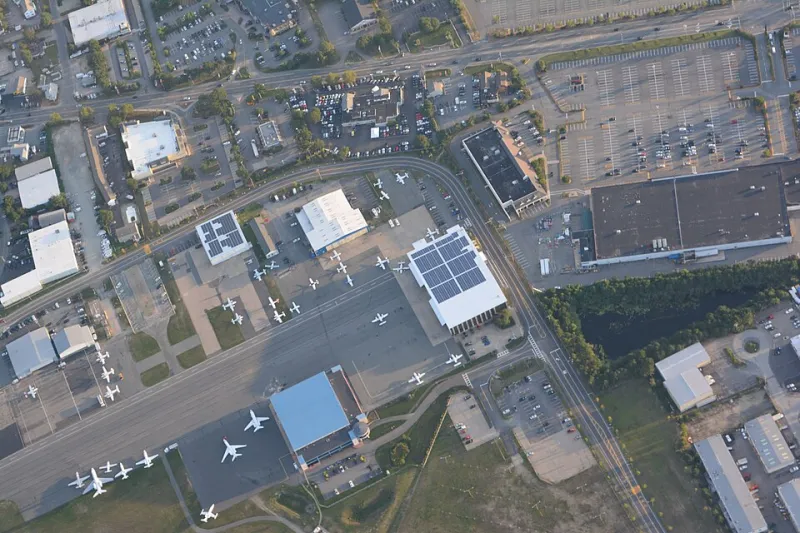
Photo: MassDOT, Public domain, via Wikimedia Commons
The enquiry tends to arrive with flattering speed: a solar developer, an electric vehicle charge point operator or an alternative network provider proposes to use the company’s roof, car park or riser cupboard, usually with a revenue share or a modest rent attached. For an SME board, the commercial logic can look straightforward. The governance question is less so. A third-party installation is not simply a maintenance matter or a procurement decision; it is a disposal of rights over premises, often for a decade or more, and it needs to be treated as such.
Begin with the lease, not the proposal
The first task is to establish what the company actually controls. A tenant may occupy the whole building yet hold only limited rights over the roof, the car park or the service risers. Many commercial leases reserve the roof and structural elements to the landlord, with the tenant granted rights of access and quiet enjoyment rather than exclusive control. Even where the demised premises include the roof, alterations, signage and subletting will usually require landlord consent.
For owner-occupiers, the title documents, any mortgage or charge, and the planning position all need checking. Airspace is not a free-standing asset that can be given away casually. If the building is held within a group or occupied under a licence, the entity receiving the proposal may not be the entity with the power to grant it.
The board should ask three questions before engaging with the developer: what does the lease or title say about the roof, car park and risers; what consents are needed from landlords, lenders or superior interests; and does the proposal interfere with existing rights, such as rights of light, access or parking allocation? If the answer to any of these is unclear, the matter should pause until it is resolved.
Licence, underlease or a bespoke access agreement
The next decision is the legal form of the arrangement. A licence is a permission to do something on land without granting exclusive possession. It is generally more flexible than a lease, can be terminable on notice, and is often appropriate for equipment that occupies a defined area without excluding the occupier. An underlease, by contrast, may grant exclusive possession of a defined space — a roof section, a group of parking bays, a riser — and can carry security of tenure risks under the Landlord and Tenant Act 1954.
Operators frequently press for a long-term lease because it supports project finance. The board should not accept that framing automatically. A licence with robust removal and reinstatement obligations may serve the company better, particularly where the installation is experimental or the operator’s covenant strength is modest. Where an underlease is unavoidable, the term, break rights, rent review and alienation provisions need close scrutiny.
There is also a middle path: a bespoke access agreement that grants defined rights — to install, maintain and remove equipment — without conferring exclusive possession. This can work well for car park charging points or rooftop solar, provided the document clearly identifies the equipment area, the access routes and the duration.
The terms that matter at board level
Whatever label is used, several substantive points should be settled before signature.
Term and exit. A 20- or 25-year term is common in the solar and EV sectors, but it may outlast the company’s lease or its plans for the site. The agreement should align with the company’s own lease term, include break rights on sale or redevelopment, and set out what happens if the operator becomes insolvent or ceases to maintain the equipment.
Insurance and indemnity. The operator should carry public liability and all-risks insurance covering the equipment and any damage to the premises. The company’s own policy should be checked for notification obligations and any exclusion relating to third-party apparatus. Indemnities should be mutual where appropriate, but the operator should bear the cost of damage caused by its installation or negligence.
Reinstatement and removal. The agreement must state who removes the equipment at the end, by when, and at whose cost. It should require the operator to make good any damage to the roof covering, structure, car park surface or services. A reinstatement bond or retention may be appropriate for large installations. Without this, the company can be left with redundant cabling, mounting frames and a dilapidations liability.
Alterations and structure. Rooftop solar adds load; EV chargers require ducting and power capacity; broadband equipment may need penetrations through the building fabric. The board should obtain a structural assessment where appropriate and confirm that the works do not invalidate roof warranties, building insurance or existing consents.
Access and operations. Maintenance visits, permits to work, safeguarding and out-of-hours access all need protocols. The company should retain control over who comes on site and when, particularly where the premises are customer-facing or subject to regulated activities.
Planning and grid. Responsibility for planning permission, building regulations and grid connection should be allocated expressly. The operator will usually lead, but the company may need to be a party to applications or consents.
Recording the decision so the site does not become a patchwork
The most common failure is not a bad clause; it is an unmanaged accumulation of agreements. A site can end up with a solar licence, two EV agreements, a telecoms wayleave and a roof access deed, each negotiated by a different person, with no single record of what has been granted or when it ends. The board should require a simple site agreement register, maintained by a named owner, recording the parties, the instrument type, the term, break dates, payment terms, insurance obligations, reinstatement duties and document location. Each new request should be considered against that register, and the decision minuted with the rationale and any conflicts disclosed.
A short annual review — perhaps alongside the premises walk-through — will catch agreements approaching renewal or break dates and identify equipment that is no longer serving a purpose.
A checklist for the next approach
Before the board responds to a developer, it should be able to answer: what rights does the company hold over the proposed area; what consent is required and from whom; is the arrangement a licence, lease or access agreement; does the term fit the company’s own lease and strategy; who insures, indemnifies and reinstates; and where will the decision be recorded? If those questions cannot be answered, the proposal is not yet ready for a signature.